Q&A: Data centers, petroleum and sustainable water in 2026
Key Highlights
- Water is a highly localized resource, making regional strategies essential for industrial water management.
- Industries are increasingly adopting recycling and reuse practices to boost resilience and meet sustainability goals.
- Different sectors require varying water qualities, from ultrapure water in semiconductors to less treated water in refineries.
- Air cooling presents a water-saving alternative for power plants and data centers, especially in regions where water resources are limited or scarce.
- Logistics and infrastructure costs are major barriers to implementing circular water practices across industries.
With the AI boom now in full swing, there has been a deeper scrutiny on water resources around the nation, particularly round the rise of data center water needs. When that lens is broadened to all industries, including the behemoth of the petroleum market, strategic questions about efficient and effective water use come into focus. And it begs an important and critical question: How can we make the energy transition and energy addition sustainable to realize a future where energy needs are effectively met without overly constraining water resources or creating contamination concerns in local water bodies?
The following is an interview from the Talking Under Water podcast in which EndeavorB2B Vice President of Energy & Utilities Bob Crossen spoke with Gabriel Collins, Baker Botts Fellow in Energy and Environmental Regulatory Affairs at the Center for Energy Studies, part of Rice University's Baker Institute for Public Policy. It has been lightly edited for clarity in a Q&A format for Water Technology, but you may also listen to the full conversation in the player below, on the Wastewater Digest website or by subscribing to the podcast.
What 2026 has in store for water in industrial contexts

Gabriel Collins: It'll depend where you are geographically and what sector you're in. Water is a hyper-local commodity. It's very different than, say, oil and gas or coal or copper, something that trades on a regional or even a global level.
Water's really localized. If you're thinking about areas that really stand out right now, particularly in the United States, data centers, as you mentioned before, certainly one. But when we think about refineries and petrochemical plants, that's a big one as well.
We see the water crunch that's taking shape down in the Corpus Christi area, and that has potentially very significant industrial implications. So where you stand on the water issue if you're an industrial depends on where you physically sit.
Industry blindspots for water needs, demands and use
BC: That makes sense because when we cover things from a municipal perspective, it is also very localized, right? Even regulatory things are very localized. Permits can be down to the city level, so things can get really narrow quickly. Do you think this presents any blind spots to the U.S. industry when it comes to water risk or water security to maintain operations for certain things like refineries or the data centers?
GC: I think of it increasingly as more of a challenge barrier than a blind spot. My general impression is that somebody who is existentially dependent on water to run their industrial operations, typically has a very keen understanding of the dynamics surrounding that water procurement and usage, and in many cases, water recycling.
I think something that you have to give increasing credit for to major swaths of the industrial world, both in the United States and abroad, is that people and leaderships recognize that water's a real issue, and there's been a lot of progress made toward boosting efficiency, but also in many cases toward recycling and reusing water. You may not close the loop and go to an entirely circular system, but you can do it to enough of a degree that you reduce pressure on the surrounding resource and also what you're fundamentally doing with those types of investments is you're boosting resilience of your operation, and that's something that is good for you from a business perspective.
Your shareholders like to see it if you're publicly traded, and then depending on what the good is that you're producing, it's something that your consumers, even if they don't realize it, will be grateful for as well if you're able to deliver a product more consistently without interruptions, even despite perhaps sometimes challenging conditions, whether it be droughts or other things that are occurring around you.
Conservation, reuse and sustainability goals accountability
BC: You mentioned a couple things there, the particularly like conservation and reuse. Is that where you're seeing the most like serious accountability for those types of things for water reuse right now in the industrial sector? Are there other elements that people are really considering? I think about better discharge practices reducing the total amount of water used for production. Are you seeing that kind of that accountability taking shape at the private sector level?
GC: It's going to depend on which sector you're looking at and what you're using the water for, and I'll give maybe two extreme ends of the spectrum.
On one end, you think of refining and petrochemical processes. You need a lot of water for cooling and things like that, where you'll have some degree of treatment, but in a lot of cases, that's water that you don't necessarily have to bring up to an extremely high standard to make it usable.
On the other end is a semiconductor fabrication plant. Basically, it's making the chips that go in your phone or your car or something like that. These guys are making water that goes into their process that is at a purity level that I think is hard for us to even conceive.
Think of that jug of distilled water in the store and then imagine something orders of magnitude more pure than that. So there it's a whole different situation in terms of what you're thinking about your water input.
Insofar as volume stability is concerned, how you're thinking about its quality, how you think about its interface with your own on-site treatment process, and then in many cases, how you recycle and reuse a significant part of that stream.
Other industries will generally fall on a spectrum in between those two extremes.
BC: Yes, in the water sector they have a saying: “the right water for the right use.” So in the sense of those semiconductors, you need this ultrapure water, but for refining or cooling towers, the water doesn't need to be as treated as that water by any stretch of the imagination.
GC: Yes, fit for purpose is a great way to think about it. And often fit for purpose evolves over time.
I'll give you an example from the oil field in the fracking sector. Recycling of produced water first really started to take off 10 to 12 years ago,
We would see these processes that, in some cases, were taking it almost to the purity of fresh water that you'd get out of a municipal tap in terms of managing your salt content and things like that. But it was very expensive. You might be spending $2-$2.50 per barrel.
And if you're doing a million barrel frack, you don't want to have to pay 2-2.5 million dollars in water for a well; that'd be a six-year cost for some of these, but fifth or a sixth of the well cost for a large frack.
And so what they learned over time is it kept evolving to a point where with some companies, and I won't name names, but they succeeded in literally, in some cases, just running water through a set of basic filters to get the solids and other things and just turned around and ran it right back down hole and fracked again.
And so sometimes with an industry, you'll see this iterative process as people adopt different water practices. They will iterate in on what's the best balance of cost and efficiency and whatever other dynamics you're concerned about.
BC: Yes. I come from the water industry, but I went to ADIPEC last November. It was the first energy thing I had been to, and I was maybe four months into trying to learn this energy world, and one of the things that I came away from that show with was that these types of sustainability practices are a bottom-line issue for a lot of these companies.
For example, the cost of water in that particular case can be so astronomical for a wellhead that it actually makes so much more sense to do these types of reuse practices, and it's a matter of like making that sustainable rather than the cost implications of the alternatives.
GC: Definitely. And you also have to think about how water relates to your costs, your operational costs overall, because if you're in a lower margin business where you need a lot of water, on the industrial side, again, this would be something like refining, petrochemicals and so forth, you're going to be much more sensitive to water costs.
For example, if you are getting surface water, we'll just call it for easy math at $200 per acre foot, if that went to $400 or $500 per acre foot, that potentially really corrodes your margins.
It's something that you very much try to avoid, whereas if you think about a data center or a semiconductor plant, water, in particular for the semiconductors, is really existential to your operations.
But if you're selling a chip wafer that's the size of a dinner plate and is worth $50,000 or $100,000, you have a lot more room to absorb a higher water cost if you need to.
And the reason I bring this up is a dynamic that we're seeing in many parts of the world and certainly in Texas. If you wanted to write a country song, you could call it “When the cheap water runs out,” and that's kind of where we are right now.
And so, what happens when you step up from water that is $100 an acre foot for agriculture to $1,000 an acre foot, for other purposes up to, in some cases more than that for specialty purposes. That's the kind of cost curve that we're thinking about now, and for different businesses, the implications can be radically different.
The pressures that data centers are putting on municipal water systems
Bob: Yes. I wanted to talk to you about data centers: What are some of the pressures that you're seeing that they are putting onto some of these utilities?
I think from my conversations with some utility professionals, like in Columbus, Ohio, for example, about a year ago, I did interviews with the water director there, and they were talking about specifically developing a water reuse plant so that they can have a data center site there. That is a tremendous amount of pressure to make sure that they can still serve their general population while also serving the needs of this industry that can be really beneficial to the community.
So, what are you seeing with those types of pressures? Is this flattened across the US, is everyone seeing pressure put on their water sources from these data centers? It's under such scrutiny right now, I'm curious about your perspective on this.
GC: I think where you are going to see the most acute pressures is when you have a data center being built in a more rural area that may be connecting to a water system that's not that large.
Because think about a water system on par with what we have here in Houston where I'm sitting, or if you're in Dallas, Fort Worth, or San Antonio or Austin or somewhere like that. You are moving in most cases well north of 100 million gallons a day. If you're talking about the Houston system, it's several 100 million.
So even a big data center that needs 5 million gallons of water per day is something that you're going to take note of when it attaches to the system, but it's not something that's going to fundamentally change the balance, even if you put a fairly significant number of them.
Whereas if you have a rural area where your system's not as big and it's not structured for this size of demand, then it's a really big deal.
I think one of the things that's really important, and this comes back to that question of what the value of water to a particular user is, is what is their capacity to pay? Maybe this is the inveterate optimist in me, but I view the data center situation in many areas as a chance to ride a large, deep balance sheet to improve municipal water systems.
And I'll give an example for that. In full disclosure, I've put forth a model contract that describes how you might do this when I went and looked at the way the city of Odessa in West Texas worked with Pioneer in 2014, which has since been purchased by Exxon. They basically signed a long-term contract to provide Pioneer with treated effluent from their wastewater plant. And the city of Midland did something similar. What this ultimately enabled were significant investments in improving those wastewater treatment systems, and you were anchored by the balance sheet of that large industrial off-taker that needed that dedicated water stream.
I think there's a very powerful analogy with data centers. And I think in some instances with a data center it's almost easier to get the two parties together for that because once you put an AI type data center online, every trend we see for compute demand is just up, up, up in terms of the amount of computing horsepower that we think we're going to need.
And so that's one way we're probably getting them into a take or pay type arrangement, and it might be an easier negotiation than with an energy company that knows that oil prices can swing 30 or 40% over any 12-month period.
Policies and incentives that could shape a sustainable water landscape
BC: I'm glad that you brought that up because that was my kind of my follow-up was about policy and incentive levers that you can maneuver to make this work and bring those parties together to realize some solutions.
In the case of that Columbus story, I think part of that conclusion was that by citing the data center there, the amount of water that the city provides can help the center offset water reuse facility costs. And then it's just a matter of, what does that P&L look like? What are the benefits?
Well, you know, how do we balance those two things against each other? So I'm glad that you brought that up because that was another question. Are there other levers that you're thinking that you've seen or you think people should be considering?
GC: I mean, in terms of explicit policy levers, there's a couple.
And I've mentioned the idea of creative contracting with municipal systems where the industrial users play a bigger role in underwriting the capital investments needed to improve infrastructure.
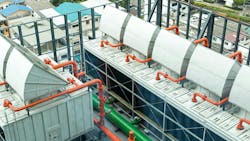
I think one other specific thing when you think of data centers, which are in some areas going to be a large water load, is thinking about air cooling. You're going to see me write more on this coming year because it's a real issue for thermal power down here in Texas as well.
And I think in other parts of the country and certainly other parts of the world where what we forget is you can air cool giant thermal operations. I mean, like I think about China, for instance, where all the coal-fired power plants at this point that are being built west of a certain longitudinal line in China, and pretty much everything has to be air cooled. You can literally see it on satellites. It just looks like a giant radiator next to the plant.
Now, obviously thermodynamics come into this and you take, I think it's a 10 or 15% load hit by air cooling versus using water. But if you're in an area where water may be almost existentially short, then that's a trade-off worth taking.
And when I think of, you know, for instance, if you have data centers in a place like Arizona, if you're thinking about Western Texas, which, you know, the Permian Basin in Northwest Texas have phenomenal potential, there's a reason we see them building a Stargate facility in Abilene. All these types of areas are ones where I think it's probably worth seriously thinking about air cooling.
Particularly for both power plants and data centers, I think in some of the drier parts of the country, it would be worth legislatures considering various kinds of incentives and regulations to promote air cooling of large operations like that might otherwise require a lot of water. What you do by that is a trade off: you pay a little bit of an electricity penalty, but you get significant resilience upside.
In a lot of these areas, it may be easier to bring in a little more natural gas to compensate for that extra load you have to use for cooling versus trying to find extra water where there may not be water or where you have to build phenomenally expensive infrastructure to bring in that water from far away.
Balancing the oil and gas energy needs of the nation against the water needs of the community
BC: Pivoting a little bit more to that oil and gas stuff, you've been bringing that up pretty consistently.
My understanding is that produce water volumes have been pretty good, but disposal wells are facing some increased scrutiny. How is this part of the industry adapting? We talked a little bit also about the bottom line being affected by these types of water choices.
So how is that part of the industry, that upstream oil and gas industry, adapting to the water concerns or the water needs that they need for operations?
GC: From what I can tell, you're seeing a portfolio approach. It's something where there's going to be a significant volume of injection disposal for a long time to come.
I think in terms of how that disposal's done, we're seeing greater spacing of wells to try to reduce localized pressures that may drive seismicity.
For instance, we're seeing more investment in basin disposal, particularly when you look at the central basin platform and you see where there may be depleted oil and gas fields or other subsurface structures that could take on meaningful volumes of water, hopefully without triggering the same kinds of seismicity and other issues we've seen in the basin. You're seeing investment in that.
At the end of the day is you're dealing with a mass balance problem, and it's fundamentally a problem that centers on the security of oil and gas production. And I think one of the things that's really important to think about is how you manage that mass balance challenge? How do you ensure continued resilience and viability of oil and gas production, which in the case of the Permian Basin is globally material? It's about 6% of global oil output.
How do you underpin all that without inadvertently creating a water security problem?
For instance if you think about the potential for aquifer contamination, if you think about people moving a little bit too quickly to use produced water physically outside of the oil field, for instance, putting it into rivers or things like that, even if it's treated, I think those are things we want to be really cautious about. And if something doesn't go right, it's very, very hard to get out, and the consequences can be decadal or even generational.
So you have to be deliberate on the front end to make sure that you keep what's an energy security problem from also becoming a water security problem.
BC: On this podcast, we talk about this whole “one water” mentality, the idea that all water has value, it's all connected at the end of the day, it's all one water, really. So one issue in one area can impact, it has a ripple effect. So sorry for the pun, but it really does.
GC: Completely appropriate. And the way I think about it too, is there's ways that you can positively affect the water supply and demand balance outside of the oil field without ever having to bring molecules across the barrier between the two.
Just to give you one example: imagine that you have a large industrial user that's based in the Permian Basin. It may be one of the new data centers going up, but maybe a thermal power plant.
If you're able to use some type of treated produced water for cooling, for instance, every barrel of water that you can get from that produced water stream is one less barrel that you must pull from a freshwater aquifer or from a freshwater resource elsewhere.
So I think this sort of virtual displacement model and the fungibility of water is important to think about. That for the oil field to positively affect the water balance elsewhere, you don't ever have to have a pipe that penetrates that barrier between them.
Think of how important the blood-brain barrier is in the human body. That's kind of how I think about that imaginary barrier between water that's really fit for purpose in the oil field versus uses of water outside of the oil field. And what you do inside of that space can still very much positively affect the availability of water outside of it without taking the risk of creating any sort of contamination or other issues that you get if you physically mix things.
How logistics are the crucial barrier to holistic, one water practices
BC: In your view, what is the biggest barrier you think to this whole idea of this one water, the circular water practices? We hear a lot about the circular water economy and the water market specifically. What is the barrier to getting all these parties involved and making sure they're all kind of moving in the same direction when it comes to circular water?
GC: So I think when you're thinking about it, and I'll lawyer you a tiny bit and give you a definition of what I think of a sort of optimized water management is I think one of the most challenging things is that you must have such significant amounts of physical infrastructure that you can virtualize things to a certain extent.
For instance, think about the regulatory regime in the Edwards Aquifer with the Edwards Aquifer Authority: they can virtualize transfers of water within their area of jurisdiction pretty effectively.
Or the case I just gave you of the oil field where you can sort of virtually displace fresh water and then have it available for other uses.
But even for those virtual civilization cases to work, within those little spheres, you need a lot of physical infrastructure in most instances. Where water is challenging is the logistics and costs of moving it.
To take a barrel of oil from Midland and move it down to the Gulf is maybe $4 or $5 in transport tariffs. You know, right now, that's, it's a little more painful because it's about 10% of your price per barrel. But if you have oil at $75 or $80, you know, you're talking 4 or 5%.
Whereas moving water depends on distance, and your transportation costs when you count capital payback and operational expenditures can be 400 or 500% of the underlying commodity value of that water.
One example is the Vista Ridge pipeline that supplies San Antonio. The royalty for that water to the owners is about $460 per acre foot, but the delivered price in San Antonio is well over $2,000 per acre foot. And that's primarily driven by the need to pay back the cost of building that giant pipeline and then operating it to move the water.
Those economics are replicated throughout the water space, so I think that the physical challenge really drives a lot of the political and economic challenges.
BC: It doesn’t surprise me that logistics is the issue.
GC: It's like talking about war. You always hear the joke that amateurs talk about strategy and professionals talk about logistics. But I think anytime you're dealing in a physical commodity environment, that the exact same adage applies.
BC: I would argue that logistics is strategy.
GC: True. That's actually a fair point because, yeah, I mean, it drives your strategy… And once you put that logistical footprint in, it shapes your operations for the next 50 years in many cases.
Where to learn more about Gabriel Collins and the Baker Institute
BC: Well, Gabriel, thanks so much for chatting with me. I feel like I learned a tremendous amount from you today, and I appreciate you taking the time.
Where can people find more information about you, or if they wanted to follow up with some of the work that you do with the Baker Institute, where can they find that?
GC: There are three best pipelines for keeping track of my work:
-
Google my name, Gabriel Collins and Baker Institute for Public Policy. My bio will come up with publications.
-
Look me up on LinkedIn. You'll see a smiling face and it says I help companies, governments, and others solve energy, food, and water problems.
-
I have a substack that I call the Sinews of Civilization. We talk about fire, food, water, and force as things that animate the human existence.
And I'd welcome you to go to any of the three or all three.
BC: Fantastic. Thanks so much, Gabe, for taking the time to speak with us today.
About the Author
 Bob Crossen
Bob Crossen
VP of Content Strategy, Energy & Utilities, EndeavorB2B
Bob Crossen is the vice president of content strategy for the Water and Energy Groups of Endeavor Business Media, a division of EndeavorB2B. EB2B publishes WaterWorld, Wastewater Digest and Stormwater Solutions in its water portfolio and publishes Oil & Gas Journal, Offshore Magazine, T&D World, EnergyTech and Microgrid Knowledge in its energy portfolio. Crossen graduated from Illinois State University in Dec. 2011 with a Bachelor of Arts in German and a Bachelor of Arts in Journalism. He worked for Campbell Publications, a weekly newspaper company in rural Illinois outside St. Louis for four years as a reporter and regional editor.