AI and H2O; Microsoft's Progress on Water Positivity Journey
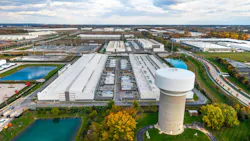
Microsoft is aiming to become water-positive by 2030, replenishing the water supply more than it consumes at its corporate, manufacturing and data center operations. It is a lofty and difficult goal in the era of artificial intelligence and cloud supercoming.
A new blog by two Microsoft company executives, however, predicts that after nearly a quarter-century the hyperscaler is close to halfway there in terms of water use effectiveness (WUE) at its data centers. Microsoft reports a 90% improvement in WUE since the early 2000s, cutting that water use intensity level from 2.3 liters per kilowatt-hour (L/kWh) to near 0.27 L/kWh in 2025.
“Beginning with some of our earliest datacenter designs, we prioritized water efficiency while minimizing impacts on energy use through the deployment of high-efficiency economizing chillers operating at elevated water temperatures,” reads the Microsoft blog jointly authored by Judy Priest, CTO of cloud operations and innovations, and data engineering vice president Steve Solomon.
“As early as 2008, we adopted direct air cooling with evaporative assist as the primary cooling approach across our datacenter fleet,” Microsoft’s Priest and Solomon write. “This design uses significantly less electricity and up to 90% less water than traditional water-based cooling systems by relying on water only when outside temperatures exceed 85°F (29.4°C).”
The recent European heat wave notwithstanding, some parts of northern Europe relied on air cooling and did not need water for cooling throughout the year. In data-center-dense Virginia, water may be required 10% of the year, while Phoenix-area data centers may require water use as much as 40% of the year, according to the Microsoft blog.
“In 2024, Microsoft introduced a new datacenter design optimized for AI workloads that consumes zero water for cooling during operations, further reinforcing our commitment to water stewardship by design,” Priest and Solomon write. “This chip-level cooling solution delivers precise zonal temperature control without water evaporation by recirculating water through a closed-loop, direct-to-chip cooling system.”
Air cooling of computing racks is the norm, with water or liquid cooling used only when outside air is above 85 degrees Fahrenheit. Microsoft says it’s also prioritizing recycled, reused or non-potable water whenever possible and necessary for data center operations.
With AI supercomputing forcing expansion of chip capacity and pushing AI-enabled data centers close to 1 GW, water scarcity is becoming a major environmental concern around the digital infrastructure industry. The Environmental and Energy Study Institute estimates that large data centers could consume five million gallons of water per day, while the World Resources Institute warns that a majority of new-build facilities are being located in water-stressed regions.
About the Author
Rod Walton
Energy Editor
Rod Walton is Managing Editor/Head of Content for EnergyTech.com and Microgrid Knowledge, as well as a regular contributor to Water Technology.
Walton is an 18-year veteran of covering energy and natural resource issues as a journalist. Prior to taking over EnergyTech and Microgrid Knowledge, he was business editor and energy writer for the Tulsa World, senior editor and conference chair for POWERGEN.