The missing measurement pice for industrial water

Industrial water facilities rarely suffer from a complete lack of instrumentation. Flow, pressure, tank level, pH, conductivity and dissolved oxygen may already be measured continuously, while laboratories provide the analytical specificity needed for chemical oxygen demand (COD), biochemical oxygen demand (BOD), nutrients, suspended solids and composition. Yet an important class of operating questions can still remain unanswered in real time: Has the incoming load changed? Is valuable product entering the drain? Has a rinse reached its endpoint? Is a treatment process seeing a different water matrix than it was an hour ago?
These are observability problems. The physical condition exists, but the plant does not yet have a reliable machine-readable representation of it at the time an operator can still respond. The distinction matters because adding another measurement is useful only if it shortens the path from a developing physical condition to a better operating decision.
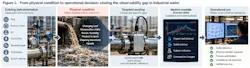
This suggests a different way to design industrial water monitoring. Instead of starting with a sensor category and asking where it can be installed, start with the state or decision that matters. Determine what existing instrumentation already reveals. Identify what remains invisible. Then select the least complex sensing and modeling approach that can make that state observable with sufficient confidence and useful lead time.
From parameters to process states
Water monitoring has traditionally been organized around parameters: pH, conductivity, turbidity, dissolved oxygen, COD, BOD, nitrate and other analytes. That structure is necessary for treatment design, compliance and laboratory analysis, but operations often revolve around a different question: what state is the process in right now?
A useful process state may be quantitative, such as a validated COD estimate. It may also be categorical or relative: normal versus abnormal influent, product-rich versus rinse water, stable versus changing composition, or a treatment signature moving away from its established baseline. In those cases, forcing the sensing system to reproduce a laboratory number may add complexity without improving the decision.
Recent industrial wastewater research illustrates the point. A 2026 study deployed a four-wavelength UV-Vis sensor at eight monitoring wells with data transmitted at five-minute intervals. Rather than reducing every measurement to a single conventional water-quality parameter, the researchers classified time-series discharge behavior into high-frequency pulsed, low-baseline stable and site-specific patterns, then investigated anomalies including bubbles, optical fouling and matrix-related signal distortion.[1] That is a different use of sensing: converting a dynamic physical process into recognizable machine-readable states.
Spectroscopy is one way to close the gap
Optical spectroscopy is useful in this architecture because it records how water absorbs or transmits light across multiple wavelengths. UV-Vis spectra can respond to aromatic organics, nitrate, color, suspended material and other matrix changes. Near-infrared (NIR) spectra provide additional composition-sensitive information through overtone and combination bands associated with molecular bonds. But the spectrum itself is not COD, BOD or another laboratory parameter. The useful output is created by the relationship between the spectral signal, reference data and process context.
This is well established in wastewater measurement. An in-situ UV-Vis system operating from 200 to 750 nm was used to estimate COD, filtered COD, total suspended solids and nitrate with multivariate calibration.[2] A later study using influent spectra from six wastewater treatment plants found that calibration to the specific wastewater matrix produced the highest accuracy. For total COD, the reported mean coefficient of variation was 12.5%, while oxidized nitrogen produced materially weaker results.[3] The implication is important: there is no universal conversion from 'spectrum' to 'truth.' Matrix, range and calibration determine whether the inferred state is defensible.
The same limitation appears in newer NIR work. A 2025 industrial wastewater study reported online COD estimation with R-squared values of 0.8640 in an equalization tank and 0.8798 after secondary settling. Yet the corresponding RMSE values were 326.6845 mg/L and 15.1917 mg/L.[4] Similar R-squared values did not mean similar absolute performance. The process location, concentration range and matrix changed the engineering meaning of the model.
Start with the blind spot, not the modality
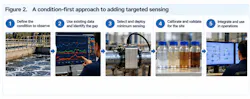
A condition-first design sequence is more robust than a sensor-first one. First define the expensive or risky condition and the decision it affects. Next map the signals already available from the PLC, SCADA system, historian, laboratory and conventional instruments. Only then determine whether an additional physical measurement is necessary.
If the missing state is strongly associated with UV absorption, UV-Vis may be appropriate. If composition or water content produces a stronger NIR signature, NIR may be the better modality. In other cases, neither may be justified. The purpose is not to maximize instrumentation. It is to maximize useful observability per unit of deployment complexity.
That principle also limits overclaiming. A model validated for one wastewater matrix, production stream or treatment location should not automatically be transferred to another. Calibration samples need to span the expected operating range and relevant transitions. Independent validation should test data the model did not use for fitting. R-squared alone is insufficient; absolute error, bias, repeatability, range coverage and fitness for the actual operating decision also matter.
The real metric is decision latency
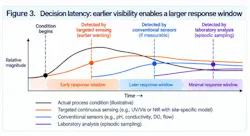
For operations, measurement frequency matters because a correct answer can still arrive too late. A laboratory result may be analytically authoritative but unable to influence an event that developed and passed between samples. Conventional online sensors solve this problem for variables they directly observe. The remaining opportunity is to do the same for physical or compositional states that are currently inferred late, indirectly or manually.
Decision latency can be defined practically as the time between the beginning of a consequential process change and the point at which an operator has enough trustworthy information to act. The objective of continuous sensing is not therefore 'more data.' It is to reduce that interval without creating an unacceptable rate of false alarms, maintenance burden or model drift.
Tertiary ozonation provides a concrete example. A 2024 study combined real-time UV-Vis monitoring with a two-step ozone-control model. The researchers reported 94.29% accuracy for predicting whether ozonation was required using linear discriminant analysis, while COD removal across the experiments ranged from 16% to 71%.[5] The broader lesson is not that UV-Vis should control every treatment process. It is that a composition-sensitive signal can move a water-quality decision from a delayed observation into the operating window where treatment can still be adjusted.
The laboratory becomes part of the continuous system
Continuous sensing does not make the laboratory obsolete. It changes the laboratory's role. Reference measurements can anchor calibration, identify bias, verify model performance and determine when a model should be retrained or rejected. Where a specified analytical method is required for compliance or quality control, that method remains authoritative.
The continuous layer serves a different purpose: filling the temporal gaps between those reference measurements. This is especially important for intermittent discharges, product transitions, cleaning events and other conditions that may be poorly represented by low-frequency sampling. The 2026 industrial-drainage study, for example, collected five-minute spectral observations specifically to capture dynamic discharge patterns that conventional low-frequency sampling could miss.[1]
This architecture creates a useful division of labor. Laboratory data provides analytical ground truth. Conventional sensors provide direct operating context. Additional sensing provides information about the otherwise unobservable state. The model connects those layers without pretending they are interchangeable.
Physical deployment can break an analytically good model
The measurement layer also has to survive the plant. Fouling, bubbles, suspended solids, optical path length, temperature, window condition and sample representativeness can all change an optical signal. These are not secondary implementation details; they are part of measurement validity.
The recent eight-site industrial wastewater deployment found turbulence-induced bubbles, large-particle spikes and optical fouling important enough to require sensor repositioning, digital filtering and inspection strategies.[1] An inline or side-stream implementation may similarly require wiping, spray cleaning, purging or another application-specific method. A model that performs well on clean reference samples can still fail operationally if the optical surface degrades or the sampled stream is not representative.
NIR illustrates the same need for bounded claims. A 2025 ethylene-glycol study reported a 0.026% limit of detection for trace water using cross-batch external validation.[6] That is evidence that the modality can resolve small composition changes in that experimental system, not a universal field specification for industrial cooling loops. A deployment would still need validation against the actual fluid formulation, additives, temperature range and optical configuration.
From signal to machine-readable state
The final step is context. A spectral change becomes more useful when it is interpreted alongside flow, pH, conductivity, dissolved oxygen, tank level, valve state, production schedule, treatment settings and laboratory history. The objective is to move from raw signal to a state that an operator or software system can reason about: load increasing, composition changing, transition incomplete, treatment drifting, anomaly developing.
This is the architecture AquaMesh is developing for industrial water operations. Existing plant data remains the starting point. Additional sensing is introduced only where an important physical condition is otherwise invisible. Laboratory data anchors calibration and validation. The resulting state is used first for operator decision support, and the outcome of the response can then be checked against subsequent process data.
AquaSpectra is the sensing layer AquaMesh is developing for those blind spots. It is intentionally different from a conventional single-parameter analyzer: the primary output is a continuous spectral fingerprint of the process stream, which can be evaluated for product transitions, composition shifts, abnormal process states, cleaning endpoints or changing wastewater load. Where the application requires a conventional parameter, the same spectral data can also support site-specific calibrated estimates such as BOD or COD, provided the relationship is validated against reference samples.
The value of that approach is reuse. A plant does not have to install a new dedicated analyzer every time the operating question changes. One validated spectral measurement point can potentially support several process-state models over time, while AquaMesh combines those states with the flow, conductivity, pH, production and laboratory data the facility already has. For a food or process plant, that can turn the same measurement infrastructure toward earlier product-loss detection, faster recognition of a cleaning or changeover endpoint, advance warning of an abnormal organic load, or verification that a corrective action actually changed the process. The economic value comes from the decision made earlier: recovering product that would have gone to drain, avoiding unnecessary processing or cleaning time, reducing wastewater loading and treatment cost, or containing a developing process problem before it becomes larger.
The broader opportunity is larger than any one sensing modality. Industrial plants already generate large amounts of equipment and process data. The missing layer is often the reliable representation of a physical condition that existing automation cannot directly see. Closing that gap is what allows analytics and AI to reason about the plant's actual state rather than only the signals that happen to be available.
A practical test for a new measurement
Before adding another analyzer, an industrial water team can ask five questions:
- What condition are we currently discovering too late?
- What decision would change if we knew it earlier?
- Which existing signals already describe part of that condition?
- What physical information is still missing?
- Can a new measurement produce that information reliably enough, with acceptable maintenance, to shorten the path to action?
That reframes instrumentation from a catalog of parameters into an observability system. The best new sensor is not necessarily the one that produces the most data or the most laboratory-like outputs. It is the one that makes an economically or operationally important condition visible early enough to change what the plant does next.