Oxidation technology offers sustainable solution for dairy operation disinfection
Key Highlights
- The Pulse Oxidation system utilizes boron doped diamond electrodes to generate ozone and hydroxyl radicals directly from water, eliminating the need for harsh chemicals.
- Field validation at Yeo Valley Farms showed up to 75% reduction in chemical and hot water use without compromising hygiene, as evidenced by Bactoscan performance data.
- This technology offers significant environmental benefits by reducing chemical waste, lowering energy consumption, and decreasing carbon emissions associated with traditional cleaning methods.
- Engineered BDD diamonds provide a durable, low-maintenance electrode solution with a wide electrochemical window, supporting consistent performance over time.
- Adopting oxidation systems like this can help dairy and food producers meet sustainability targets while maintaining high hygiene standards and reducing operational costs.

For decades, the essential task of disinfecting and cleaning milk lines in dairy parlors has been undertaken by well-known and effective treatments based primarily around aggressive cleaning chemicals and hot water.
The need to conduct such cleaning and sanitization is not in question. The requirements to protect valuable dairy herds from diseases such as mastitis, which has been estimated to cost the U.S. agriculture sector more than $1 billion alone per year1, and the need to keep bacterial load under control to ensure adequate quality of milk, are well understood and deemed completely necessary. The sanitization programs are necessary and the challenge is global.
Conventional disinfection methods and chemicals for dairy wastewater
While effective, conventional methods come with drawbacks.
As environmental awareness and regulation have increased across the globe over the past decades, these downsides have become more prominent. Challenges relating to the use and disposal of harsh chemicals, such as sodium hydroxide (a commonly used alkali cleaner), and peracetic acid (an acidic disinfectant and cleaner), as well as the ubiquitous detergent sodium hypochlorite, have become increasingly high profile in recent years, and not for good reasons.
These chemicals, while cheap, freely available and effective, do not breakdown, and are still present when the wash cycles are completed. As such they often end up being disposed straight into the drain, and the environmental impact of this process is significant.
Another issue with using alkali cleaners in particular is the necessity to utilize large quantities of hot water to kick start the reaction and optimize the effectiveness of the process. The use of this much heat energy every day has also drawn the attention of those focused on making agriculture more sustainable, and water use more efficient.
Oxidation technologies may provide an answer
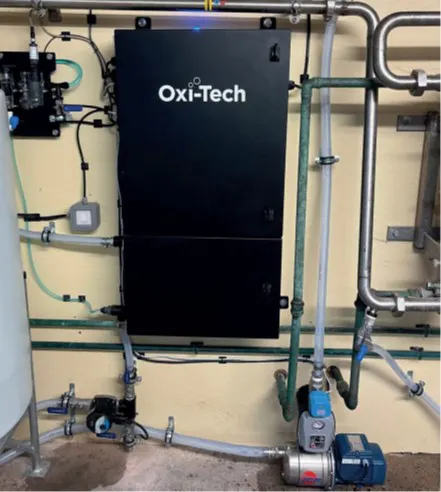
In response to these challenges, Oxi-Tech’s Pulse Oxidation system, which uses Element Six’s boron doped diamond (BDD) technology, is a solution that has taken aim at reducing these environmental impacts. The system replaces the chemical and hot water use with an ambient temperature process that uses electrolytic generation of ozone (O3), hydroxyl free radicals (OH*) and monomolecular oxygen (O*) directly from the feedwater, and injects them into the parlors’ clean-in place (CIP) system. With this process, the dairy industry and broader food and beverage industry, has access to an efficient, sustainable and cost-effective substitute to traditional chemical treatments.
The use of such compounds means that the efficacy of the disinfection wash and cleaning cycles should not be compromised (the compounds typically have a half-life of around 20 to 30 minutes at ambient temperatures), but the environmental impact is significantly reduced as the byproduct from the process is clean water. In addition, the reduction in heat energy increases the sustainability of the operation, improves efficiency and reduces cost.
An organization interested in reducing its chemical use, improving its sustainability footprint and increasing efficiency is Yeo Valley Farms, which is part of the Yeo Valley group, the largest organic dairy brand in the UK.
Yeo Valley elected to install the Oxi-Tech Pulse Oxidation system at its Yoxter Dairy Farm in Somerset, England. Furthermore, it conducted a study to validate the technology in the field in so it could compare the solution with its traditional chemical treatments.
An unexpected technology ingredient: Industrial synthetic diamond
At the core of Oxi-Tech’s Pulse Oxidation system is BDD, an engineered diamond material pioneered by Element Six. By introducing boron into the diamond structure, the material becomes electrically conductive while retaining diamond’s durability and chemical inertness.
This combination enables BDD to function as a highly efficient electrode, generating oxidative species, including ozone, hydroxyl radicals, and reactive oxygen, directly from water when current is applied. These oxidants are effective at destroying bacteria, biofilms, and organic contaminants without requiring added chemicals.
A defining advantage of BDD is its wide electrochemical window, allowing high oxidant generation with minimal electrode degradation or unwanted reactions. These electrodes are not subject to wear during operation, supporting consistent performance with low maintenance requirements. In dairy CIP systems, the technology serves as the enabler of in-situ oxidation, converting water and electricity into a reliable cleaning and disinfection solution.
While largely invisible within the system, engineered BDD diamond is the key technology that enabled Yeo Valley Farms to reduce its chemical use, lower energy demand, and maintain effective hygiene performance, making it the unexpected secret ingredient behind the process.
How Yeo Valley Farms validated the oxidation technology
The validation program was conducted between December 2025 and March 2026, when the technology was introduced in stages to allow performance to be monitored at progressively higher replacement levels. Three operating phases were evaluated:
- 1:1 wash replacement
- 2:1 wash replacement
- 3:1 wash replacement
The staged approach enabled the farm and Oxi‑Tech to assess performance as conventional chemical use was progressively reduced. At the highest replacement level, a 3:1 ratio corresponded to approximately 75% reductions in both chemical consumption and hot water use.
In terms of data collection, Bactoscan data collected during the validation trial formed the benchmark key performance indicator. To create a meaningful comparison, results obtained during operation were matched against historical farm data collected between 2019 and 2024 during the same seasonal period. This seasonal matching approach reduced the influence of natural variations that can occur throughout the year.
The data analysis used geometric mean rather than simple arithmetic averages, because Bactoscan data can be affected by occasional spikes, which may distort conventional mean average trends. Geometric means provide a more representative measure of long‑term performance.
In addition to stage‑by‑stage comparisons, rolling geometric mean trend lines were produced to show underlying performance patterns over time. This approach allowed the analysis to focus on sustained hygiene performance rather than isolated short‑term fluctuations.
Performance results from the validation study
The study demonstrated that the technology maintained strong milk hygiene performance throughout all operating phases.
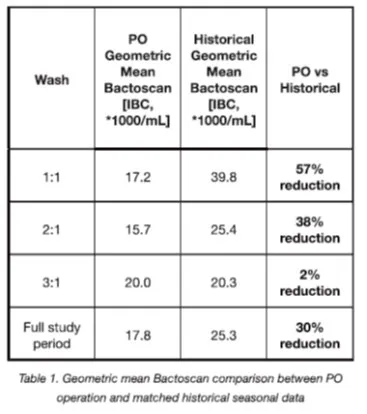
- At the 1:1 replacement stage, the system achieved a geometric mean Bactoscan result of 17.2 IBC x1000/mL compared with 39.8 IBC x1000/mL for the matched historical seasonal data. This represented a 57% reduction in Bactoscan levels.
- At the 2:1 replacement stage, the technology produced a geometric mean result of 15.7 IBC x1000/mL compared with 25.4 IBC x1000/mL historically. This represented a 38% reduction in Bactoscan relative to the matched data.
- At the 3:1 replacement stage, the geometric mean increased to 20.0 IBC x1000/mL while the historical comparator was 20.3 IBC x1000/mL. Although performance converged, the oxidation system still achieved a 2% reduction in Bactoscan compared with the benchmark despite operating with substantially reduced chemical and hot water inputs.
Across the entire study period, the geometric mean Bactoscan value during operation of the oxidation process was 17.8 IBC x1000/mL. The matched historical comparator recorded 25.3 IBC x1000/mL. Overall, this represented a 30% reduction in Bactoscan levels while progressively increasing chemical replacement rates and lowering hot water inputs.
The validation data showed that the system’s performance remained consistently competitive with, and often superior to, the historical seasonal data throughout of the majority of the study period.
Within the data, temporary spikes in Bactoscan values were observed, particularly during the 3:1 replacement phase. However, such spikes are common in dairy operations and may be influenced by numerous factors outside the CIP system itself. Those factors include herd health, milking hygiene, equipment condition, weather conditions, and routine operational variations.
To emphasize this point, similar spikes were also present within the historical comparison dataset. For this reason, the analysis focused on overall trends and geometric mean performance rather than isolated events. When assessed through this methodology, the results indicated the oxidation technology maintained effective hygiene control while reducing the use of conventional cleaning inputs.
Operational benefits and environmental impact
The results suggest several practical advantages for dairy as well as food and beverage operators.
Firstly, the BDD-enabled technology allows substantial reductions in chemical utilization. At the highest replacement level, chemical use was reduced by approximately 75%. This lowers purchasing requirements, storage needs, handling risks, and disposal volumes associated with conventional cleaning chemicals.
Secondly, the system lowered hot water demand. Because it generates its cleaning solution from cold water, dairy producers can reduce energy consumption associated with water heating. Lower energy usage contributes directly to operating cost savings and supports sustainability objectives.
As for environmental benefits, reduced chemical consumption lowers the volume of chemicals entering the wider waste stream and decreases the environmental burden associated with manufacturing, transporting, storing, and disposing of cleaning products.
Similarly, lower hot water usage reduces energy demand and associated carbon emissions. For dairy producers as well as food and beverage producers seeking to improve sustainability performance, oxidation systems like this offer a route to reducing resource consumption without compromising hygiene standards.
About the Author
Paul Morris
CEO, Oxi-Tech Solutions
Paul Morris is the CEO of Oxi-Tech Solutions Ltd.He has spent the last 25 years working in business management in the scientific and technical sector. Originally trained as an industrial chemist, he spent more than 10 years in the water testing industry where he grew commercial environmental water testing businesses from the UK to Australia. He has spent the last 12 years building up clean technology businesses in air and water in the U.S., Europe and China.