FERC Approves Largest Pumped Storage Project in Decades
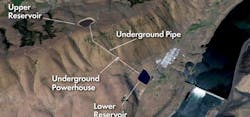
Federal regulators have approved the biggest U.S. hydropower pumped energy storage construction project in more than a decade.
The planned 1.2-GW Goldendale Energy Storage project was granted a 40-year license to operate by the Federal Energy Regulatory Commission. The project is being developed on private and public lands at the site of a former aluminum smelter in Klickitat County, Washington.
Rye Development is spearheading the project which, when operational, will store electricity for up to 12 hours and generate enough capacity to power about 500,000 homes and businesses in the growing region of southern Washington and northern Oregon.
“This is a landmark moment for the Pacific Northwest,” said Erik Steimle, Rye Development’s chief development officer, in a statement. “With electricity demand and energy costs on the rise, this license represents a huge step toward a more reliable grid and affordable energy prices for the region.”
The previous pumped storage project of this magnitude was the Bath County site in Virginia four decades ago. Rye Development, which is a partnership of EDF and Climate Adaptive Infrastructure, also is working on the 287-MW Lewis Ridge Pumped Storage project in Bell County, Kentucky.
Goldendale is expected to create jobs for close to 3,000 people during its construction period over the next four to five years. It is located within the Tuolumne Wind Farm and thus will use existing roads and electric transmission lines.
“The Goldendale Energy Storage Project is a win for middle-class, family-wage jobs and rural communities,” said Heather Kurtenbach, executive secretary of the Washington State Building & Construction Trades Council, as quote in the Rye Development press release. “We’re excited to collaborate with Rye Development on what will be one of the largest construction projects southeastern Washington has seen in decades.”
Investor Copenhagen Infrastructure Partners is working with Rye to help develop Goldendale Pumped Storage.
Rye Development first applied for FERC approval five years ago. The electricity generated will be tied to the Bonneville Power Administration grid.
Goldendale pumped storage is designed as a “closed loop” system although it will receive fill and replacement water from a non-project pumping station located on an intake pool adjacent to the Columbia River.
Goldendale’s entire project site will cover nearly 700 acres, including 530 previously owned by NSC Smelter and 18.1 acres owned by the U.S. Army Corps of Engineers, according to the FERC order. The upper reservoir will be in the Columbia Hills area above and to the north of the Columbia River.
Project owners and operators will purchase 7,640 acre-feet of water from Klickitat Public Utility District to initially fill the reservoir.
Pumped storage is basically hydropower with a twist: Water is pumped to a higher elevation pool while electricity rates are lower, such as at night or early morning, and then it is released to turn power turbines and generate power when demand is at its highest.
At the Goldendale site, the powerhouse will be in an underground cavern. It will be centered around three 400-MW Francis-type pump-turbine units.
The region around Goldendale in southern Washington and northern Oregon is expected to grow significantly over the coming decade, even as related coal-fired and gas-fired capacity is being retired, according to the FERC document.
The North American Electric Reliability Council (NERC) most recent report “indicates internal demand in the WECC Northwest region is projected to grow at an annual rate of 1.61% from 2025 through 2034,” according to the FERC order. “During the same period, the anticipated reserve capacity margin (generating capacity in excess of demand) in the region is forecasted to decrease from 38.7% in 2025 to 4.6% in 2034.”
Reporting and writing by Rod Walton
EnergyTech/Microgrid Knowledge Head of Content