USGS releases groundwater quality report
Key Highlights
- The USGS produced a comprehensive analysis of groundwater quality from 1988 to 2022.
- The study represents groundwater quality for about 5 million people.
- The report details prevalence and trends of geogenic groundwater contaminants and mixtures.
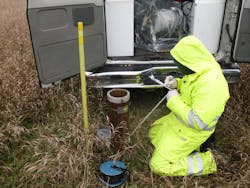
The United States Geological Service (USGS) produced a comprehensive analysis of groundwater quality from 1988 to 2022.
The full report provides foundational information about the prevalence and trends of geogenic groundwater contaminants and mixtures, which can be used by water-resource managers and the public health community to help protect human health.
Between 1988 and 2022, elevated concentrations (exceeding half of an established human-health benchmark) of geogenic contaminants were widespread in groundwater wells across the country. Some of the most elevated contaminants included arsenic, lithium, radium, sulfate, and uranium. Elevated concentrations of these contaminants are particularly concerning for the 37 million people who use domestic wells for their drinking water, as domestic wells are typically not regulated and require individual users to monitor and treat their own water.
The study represents groundwater quality for about 5 million people. According to the USGS analysis, more than 2.3 million Americans with domestic wells may be exposed to elevated concentrations of one or more geogenic contaminants. Although this study provides unprecedented national-scale information, its results represent water quality for only a small portion of domestic well users nationwide.
Overall, increasing concentration trends were more common than decreasing trends for most geogenic contaminants. Concentrations and trend patterns, however, differed by aquifer type, constituent geochemistry, groundwater geochemistry, well depth, and land use. The drivers of chloride concentrations, for instance, varied regionally, with road-salt application likely driving increased chloride in the northeastern US compared to evaporative processes driving concentration increases in the western US.
In domestic well networks, many contaminants had elevated concentrations that affected 90,000 people or more. Some contaminants also saw increasing trends while others saw more stable dynamics. For example, concentrations of lithium, manganese, radium, and uranium tended to increase through time, whereas concentrations of fluoride and molybdenum remained stable.
Mixtures of elevated concentrations of two or more contaminants were common, and the complexity of mixtures increased over the study time span. The regulated contaminants arsenic and uranium were present in many of the most common mixtures, indicating an emerging threat to human health. Human-health benchmarks do not account for the effects of contamination mixtures, and it is unknown whether exposure to multiple contaminants has adverse, additive human-health effects.
While there were overall more increasing concentration trends, there were some contaminants that showed a more promising story. For example, only one well network showed significant increases in fluoride, with the rest having either decreasing trends or stable values over time. On top of that, only about 1% of sites had elevated or high concentrations of fluoride. Fluoride helps prevent tooth decay in small amounts but is harmful for bone health at high concentrations.
When groundwater moves through the rocks and sediments that make up an aquifer, some of the minerals in or adhered to those rocks and sediments are released into the water. Concentrations of trace elements like arsenic, manganese, strontium, and lithium, therefore, are more likely to be a concern in groundwater than in surface water. Humans affect the release of geogenic contaminants when they modify groundwater flow patterns or geochemistry through activities such as groundwater extraction or accelerated aquifer recharge.
For example, summer irrigation of crops and urban landscapes has caused shallow, young groundwater that contains high concentrations of uranium to migrate deeper to drinking water aquifers. The eastern San Joaquin Valley in California has such a situation, where uranium concentrations in groundwater commonly exceed federal and state drinking water standards.