Data center cooling plans require peak water estimates
Key Highlights
- In 4 years, data center cooling systems could require an amount of water roughly equal to the typical daily water supply of New York City.
- Annual water requirements can appear significantly below this estimate, but systems have to be built to meet peak demand on the hottest days.
- To achieve this supply, community waterworks across the United States will need $10 billion to $58 billion in new infrastructure.
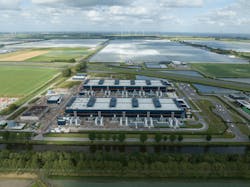
Without new water sources, in 4 years data center cooling systems could require 697 million to 1.45 billion gallons of additional peak water capacity per day, an amount roughly equal to half to the total typical daily water supply of New York City, according to a study by a UC Riverside research team in collaboration with Caltech.
The report, entitled “Small bottle, big pipe: Quantifying and addressing the impact of data centers on public water systems,” quantifies the amount of water needed to cool millions of servers in data processing centers which use evaporative cooling systems. To achieve this supply, community waterworks across the United States will need $10 billion to $58 billion in new infrastructure to meet spikes in data center water demands during peak usage, assuming enough water will be available.
While most data center water reports reference annual water use, the study examines municipal utility supply during peak demand on the hottest days of summer. In many cases, daily water demand from evaporative cooling systems can spike 6–10 times higher than average usage. For some planned facilities, this figure may exceed 30 times.
On hot days, a large data center can withdraw more than a million gallons of water, and some facilities under construction have been allocated up to 8 million gallons daily. The challenge with these peaks is that it forces water utilities, which mostly comprise local government entities, to build water treatment plants, storage reservoirs, pump stations, transmission pipelines, and wastewater treatment capacity capable of handling peak demand, even if the capacity is rarely used.
Many public water systems are aging and financially constrained, and Environmental Protection Agency estimates the nation’s water and wastewater infrastructure already faces trillions of dollars in funding requirements over the next two decades for upgrades and maintenance.
To address the problem, the report has made three recommendations. First, data center developers should report peak water use, not just yearly averages. Second, data center companies could partner with local communities to fund water infrastructure upgrades with verifiable outcomes, preventing expansion costs from falling entirely on local ratepayers. And third, data centers could work more closely with utilities by adjusting cooling methods such as water-based cooling when the power grid is stressed and dry cooling when the community water system is stressed.