Jordan approves US grant for water desalinization project
Key Highlights
- Jordan approved a $203 million US grant for the Aqaba-Amman Water Desalination and Conveyance Project.
- The $6 billion project includes a desalinization plant, pipeline, and a solar power plant.
- Construction will start after financial closure, expected within weeks.
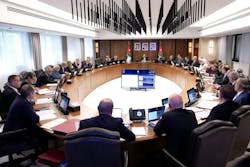
Jordan approved a $203 million US grant for the Aqaba-Amman Water Desalination and Conveyance Project, also known as the National Water Carrier, said The Jordan News Agency in a March 17 release.
The government is proceeding with its implementation phases to ensure completion within 4 years. The project involves development, construction, and operation of a seawater desalination plant, a 438-km underground water conveyance system, a 281-MW solar power plant, and associated infrastructure.
The National Water Carrier is the third-largest water project in the region and will produce 300 million cu m/year of drinking water, of which 250 cu m/yr will be conveyed to Amman and 50 cu m/yr to Aqaba.
The desalinization plant uses a deep-water intake system to avoid coral reef larvae and a high-velocity brine discharge system to return salinity to normal levels within 20–50 m of the outlet. The solar farm in the Al-Quweira region will supply about 28% of the project’s power requirements.
The results of the Project will be measured through the annual desalinated drinking water supply, the percentage of energy consumption sourced from the self-consumption solar farm, and the reduction in greenhouse gas (GHG) emissions. The Project’s environmental and social risks and impacts will be assessed in accordance with the European Bank for Reconstruction and Development (EBRD) Environmental and Social Policy 2019 and related performance requirements.
The Project is a Public Private Partnership (PPP) between the Ministry of Water and Infrastructure (MWI) of Jordan and National Carrier Project Comp. (NCPC), a special purpose vehicle owned 90% by Meridiam and 10% by Suez.
The Green Climate Fund committed $6 billion for the project, with other financing coming from EBRD, Asian Infrastructure Investment Bank, International Finance Corp., and grants and loans from multiple countries. NCPC is providing 15% of project costs through private equity.
Construction will start after financial closure, which is expected to be finalized within weeks.