Amazon reports industry-leading data center water efficiency
Key Highlights
- Amazon reported that its global data center network consumed seven times less water per kWh than the industry average.
- The efficiency was through air and evaporative cooling methods.
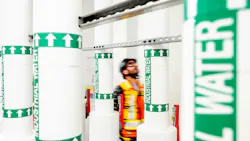
Amazon reported that its global data center network consumed water at a rate that’s over seven times more efficient than the industry average. It is a 52% improvement in water use intensity since 2021 and comes as scrutiny of the digital sector's resource footprint intensifies worldwide.
Amazon’s data centers consumed on average 0.12 Liters of water per kilowatt-hour (L/kWhr) in 2025, compared with the 0.84 L/kWh industry average.
Cooling Methods
Amazon’s data centers use free air cooling about 90% of the time,which pulls in outside air, runs it past servers to absorb heat, then pumps it back outside with no water involved.
During the hottest hours of hot days, when the air gets too hot and humid to cool the servers effectively, Amazon switches to evaporative cooling, in which water is sprayed onto an absorbent medium. Hot air flows through the water-soaked material, and as the water evaporates, it pulls heat from the air, cooling it by five to 10 degrees.
Additionally, Amazon has been steadily raising the temperature thresholds at which their data centers operate, designing servers to tolerate more heat to reduce the number of hours they need water for cooling. After a few years of iteration, learning, and adjusting, they now use water to cool incoming air only when ambient temperatures exceed about 85° F.
To validate the approach, Amazon analyzed thousands of hours of data across data center campuses, checking failure rates at higher temperatures. The failure rate did not increase. Two identical data centers on the same campus were compared, and the one running at higher temperatures used about 50% less water. In Northern Virginia, the company’s largest region by IT load, water use dropped by 42% year-over-year, even as demand for computing continued to grow.
In 2025, the company withdrew about 2.5 billion gallons of water across its entire global data center footprint during the entire year. At the sites Amazon owns and operates directly, the total amount of water withdrawn decreased 2% from 2024 to 2025.
Water Reclamation
Amazon is committed to being water positive by 2030 and reports that they are already about 75% of the way there. The company tracks how much water it uses to gauge how much must be returned. The company is also investigating methods to capture water that would be otherwise wasted. Some of these water capture projects include:
· Hermiston, Oregon, where Amazon is funding a project to pull water from the Columbia River during peak winter flows and storing it in an aquifer for use during drier parts of the year.
· Northeastern Spain, where a pipeline moves runoff water from upstream fields to a poplar grove in the town of Pina del Ebro, reducing the need to pull irrigation water from the Ebro River.
· Near Guadalajara, Mexico, where a watershed restoration project helps the ground absorb more rainwater and aids in stopping pollution from flowing into the Santiago River basin.
In total, over 50 water projects are expected to return more than 5.8 billion gallons of water annually for use by local communities.
Amazon is also using water in its operations that would otherwise be unusable. This reclaimed water is sourced from wastewater treatment plants. The company is already operating 26 facilities using 100% reclaimed water, with 130 more contracted globally.