IEEFA finds scarce water resources for Texas hydrogen and CCS
Key Highlights
- The IEEFA suggests that Texas's hydrogen and CCS projects could be risked by severe water shortages.
- By 2040, total water demand from these projects could surpass current water plan estimates
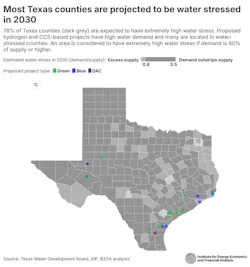
An Institute for Energy Economics and Financial Analysis (IEEFA) report finds that water resources may prove to be the weakest link in project viability for hydrogen and carbon capture and storage (CCS) projects.
In Texas, 78% of counties are considered to have extremely high water-stress, and almost half of its counties have water demand projections that equal or surpass supply. The 2027 State Water Plan predicts that Texas demand will outpace supply by 16% by 2030 but does not include sources of significant water demand that have emerged in the last few years, including hydrogen production and CCS projects.
Statewide, the planned hydrogen and CCS-dependent projects most likely to be completed could require an additional 57,000 acre-ft (18.6 billion gal) of water per year, putting significant new strain on the state’s already-stressed water supplies. Projects that are in early phases of development have an additional 49,000 acre-ft (15.9 billion gal) of water associated with them. If all these projects are built out to their proposed levels by 2040, there would be about 106,000 acre-ft of demand that is not currently accounted for in the 2027 water plan.
As pressure to expand water-intensive industries increases, Texas will be hard-pressed to develop sufficient water resources to accommodate project plans. Investors should also factor increasing supply concerns into their decisions on proposed projects.
The IEEFA provides independent, evidence-based financial analysis of global energy markets, investment trends, and policies.