Mining’s water challenge: Active treatment and centrifuge innovation in acid mine drainage control
Key Highlights
- Acid mine drainage results from sulfide minerals exposed during mining, producing acidic, metal-laden runoff that impacts waterways globally and costs billions to mitigate.
- Passive treatment systems, while low-cost, are slow and require large land areas, making them less suitable for long-term, high-volume AMD management.
- Active treatment plants utilize chemical dosing and mechanical separation, offering faster, more predictable results and smaller footprints, ideal for strict regulatory environments.
- Horizontal decanter centrifuges enhance sludge handling by dewatering to 50% solids, enabling easier transport, reducing disposal costs, and supporting water reuse.
- Mobile treatment units provide flexible, cost-effective solutions for legacy sites or remote locations, facilitating continuous AMD management without permanent infrastructure.
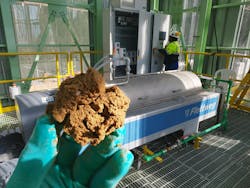
Across the globe, acid mine drainage (AMD) remains one of mining’s most stubborn and costly environmental legacies. Known variously as abandoned mine drainage, acid rock drainage or mine-influenced water, the phenomenon occurs when sulfide-bearing minerals are exposed to air and water, triggering a chemical reaction that produces acidic, metal-laden runoff.
The U.S. Environmental Protection Agency estimates that AMD has impacted thousands of miles of waterways, with the global cost of mitigation projected at more than $40 billion USD. While natural processes and volcanic activity can produce similar chemistry, the overwhelming majority of AMD is linked to mining activity — particularly in coal, polymetallic and copper operations.
Regions such as the Appalachian coal belt and South Africa’s Gauteng Province face especially acute impacts. In Gauteng alone, legacy mines discharge an estimated 350 million liters of contaminated water every day into a water system already under stress.
What is AMD?
At its core, AMD begins with a simple but destructive chemical reaction. When sulfide-rich minerals such as pyrite (FeS₂) are exposed to air and water — conditions often created when rock is excavated during mining — oxidation produces sulfuric acid. This acidic solution leaches metals including aluminum, manganese, zinc, copper, lead and cadmium from surrounding rock, creating an orange or reddish precipitate familiar to anyone who has seen polluted mine runoff.
While this process can occur naturally, such as through long-term weathering in places such as the Yellowstone Mountains or during volcanic activity, most AMD cases are tied directly to mining. Excavation exposes fresh rock surfaces to the atmosphere, and water ingress — from rainfall, runoff or groundwater — sets the reaction in motion. The resulting acidic, metal-laden water can emerge from both active mines and “legacy” sites long after production has ceased.
Why traditional approaches struggle
For decades, passive treatment systems have been the preferred method for addressing acid mine drainage, largely because of their comparatively low capital cost and minimal operational requirements. Typically built as a sequence of ponds, wetlands or limestone beds, these systems neutralize acidity through a series of biological and chemical steps. The first stage often involves introducing organic compost and limestone or caustic material to raise pH and remove oxygen. The flow then moves through oxidation ponds, where dissolved metals begin to precipitate, before reaching final “polishing” wetlands designed to release water with improved clarity and reduced acidity.
While effective under certain conditions, passive systems are not without significant limitations. The treatment process is inherently slow, requiring long retention times and therefore large land areas — something not always available at active mining sites. Over time, the “sacrificial zones” can become biologically sterile, offering limited habitat for flora and fauna. Maintenance becomes increasingly challenging as organic matter and limestone need replenishment, and accumulated sediments must be periodically dredged to maintain settling capacity.
A further complication lies in sludge management. The hygroscopic nature of the waste means it retains water, resisting compaction and creating instability during transport. In many cases, moving this material to a final disposal location requires costly road transport. For these reasons, passive systems are often better suited to post-closure phases or short-term remediation projects rather than as a long-term, high-volume treatment solution — especially where discharge regulations are tightening.
Active treatment: A more controlled path to compliance
Active treatment systems take a fundamentally different approach, relying on purpose-built plants to achieve faster, more predictable results. These facilities use a sequence of chemical dosing, pH adjustment, oxidation and mechanical separation to rapidly remove contaminants and meet regulatory standards.
The process typically begins in a conditioning tank, where lime slurry is added to raise the pH and neutralize acidity. The water then flows through neutralization reactors, where oxidation reactions cause dissolved metals to precipitate. A polymer-assisted thickening step follows, separating the clarified overflow from the concentrated underflow sludge. This thickened sludge is then ready for further dewatering — often through centrifuge technology — while the clarified water can meet strict discharge criteria or be reused in mining operations.

Although active systems require greater capital investment and ongoing operating expenditure for chemicals, energy and maintenance, their benefits are substantial. They occupy a smaller footprint than passive systems, deliver consistent water quality and eliminate the need for large settling ponds. In some cases, active plants can also support recovery of rare earth elements or other valuable materials, partially offsetting operational costs. For mines facing high flow rates, tight environmental regulations, or community pressure to reduce water impacts, active treatment offers a controlled, scalable path to compliance and improved environmental performance.
The role of centrifuge technology in AMD treatment
Within active treatment systems, horizontal decanter centrifuges are emerging as a critical component for sludge management. These machines use high rotational forces to separate solids from liquids, producing a drier, more stable cake and recovering additional water — referred to as centrate — for reuse.
In the context of acid mine drainage, sludge generated after neutralization and thickening often remains difficult to handle due to its hygroscopic nature. Even after polymer-assisted thickening, the material typically contains only 2%–5% solids by weight. This high moisture content makes it unstable for transport and prone to re-suspension if stored in ponds.
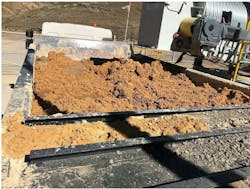
Centrifuges address this by further dewatering the thickened sludge to approximately 50% solids by weight. At this dryness level, the material can be handled using loaders, conveyors or trucks without risk of excessive leakage or instability. In addition to improving transport logistics, this dryness reduces overall disposal volume and cost.
A mining-configured horizontal decanter centrifuge typically receives feed from an upstream homogenizing tank, where solids concentration and particle distribution are stabilized for consistent performance. Feed enters the rotating bowl through a stationary feed tube, accelerating to operating speed. Centrifugal force pushes the denser solids outward to the bowl wall, while clarified centrate collects toward the center for discharge. An internal scroll conveyor moves the solids toward the conical end of the bowl for discharge at the designed dryness.
The benefits of centrifuge integration extend beyond dryness. The recovered centrate — often at a neutral pH and with minimal suspended solids — can be reused in mining operations or safely discharged, reducing the demand for fresh water. Centrifuges also eliminate the need for expansive settling ponds, reducing the environmental footprint and associated regulatory risks.

In high-altitude or remote mining locations, mechanical dewatering can also improve system resilience. Because centrifuges operate continuously, they can adapt to fluctuations in flow and solids concentration without requiring large buffer storage. This makes them particularly well-suited for sites transitioning from batch to 24/7 operations, or for mobile treatment units serving multiple legacy sites.
While capital costs are significant, the combination of reduced transport volume, lower disposal costs and water recovery can offer long-term operational savings. In an industry increasingly focused on both environmental stewardship and operational efficiency, centrifuge technology provides a scalable, proven solution for one of mining’s most persistent wastewater challenges.
Case study: High-altitude polymetallic mine in Peru
A large polymetallic mine in Peru’s Andean region illustrates how centrifuge technology can integrate into an active AMD treatment train. Located between 2,200 and 3,300 meters above sea level, the site operates in a semi-dry climate with temperatures ranging from –5 °C to 25 °C. Rainwater runoff from overburden dumps generates acidic drainage, creating both safety and environmental concerns.
The mine’s treatment plant — positioned two kilometers from the processing facility — includes clarifiers, neutralization tanks, polymer dosing systems and a two-phase decanter centrifuge. Originally operated in batch mode, the plant transitioned to continuous operation in 2025 to accommodate higher sludge volumes and ensure 24/7 treatment.
During commissioning, feed to the centrifuge averaged 3.5% solids by weight. After processing, the solids reached 50% dryness, with centrate pH measuring 6.9 and free of significant suspended solids — meeting criteria for reuse on-site. The drier solids are easily transported for final disposal, cutting handling time and costs.
Mobile treatment units: Flexibility for legacy sites
Not all AMD problems are centralized or near existing infrastructure. For regions with multiple legacy sites or constrained mine locations, mobile AMD treatment units offer a practical solution.
Mounted on flatbed trucks or trailers, these compact systems combine a clarifier, polymer dosing, pumps, sensors, controls and a mining-configured centrifuge in one transportable package. This allows operators to move the system between sites as needed, delivering consistent performance without the capital investment of multiple permanent plants.
Such flexibility is particularly valuable for municipalities or small operators with limited budgets but pressing environmental obligations.
Looking ahead: From compliance to sustainability
The growing challenge of acid mine drainage demands more than reactive measures — it requires scalable, long-term strategies that balance environmental responsibility with operational practicality. The use of centrifuges for neutral sludge dewatering represents a proven, effective and increasingly economical alternative to conventional methods.
By mechanically separating solids and liquids through centrifugal force, mining operators can reduce the footprint of treatment systems, recover valuable process water and produce solids stable enough for safe transport and disposal. In regions where water scarcity, environmental regulation and community expectations converge, these advantages are more than operational benefits — they are the foundation of a sustainable mining strategy.
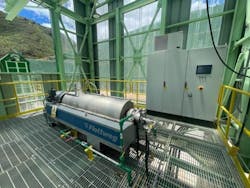
The experience from high-altitude mines in Peru demonstrates that centrifuge-equipped active treatment systems can operate continuously in challenging climates, delivering consistent results and enabling compliance with strict discharge requirements. Likewise, mobile treatment units offer a flexible approach for addressing AMD across multiple sites without the capital burden of permanent installations.
As mining companies face increasing scrutiny over environmental impacts, technologies that deliver both reliability and adaptability will be critical. Mechanical separation by centrifugation is not a new concept — it has decades of proven performance in industries from wastewater treatment to mineral processing. But its targeted application in AMD management is reshaping how the mining sector can meet today’s challenges and prepare for those ahead.
For operators seeking to move beyond mere compliance toward true environmental stewardship, integrating centrifuge technology into AMD treatment systems offers a path forward that is both practical and progressive — a solution built to meet the demands of the present while safeguarding resources for the future.
About the Author
Stephen L. Benyo
Global Mining executive for Flottweg Separation Technology
Stephen L. Benyo is a global mining executive for Flottweg Separation Technology. He is engaged in placing the “puzzle-piece” of innovative technology in its most needed locations — striving toward more efficient utilization of our world’s natural resources. He can be reached at [email protected]