Optimizing wastewater treatment when segmentation isn't possible
Key Highlights
- Industrial wastewater varies widely in key water-quality parameters, making consistent treatment challenging for facility operators.
- Multi-stage treatment trains can experience performance declines due to upstream changes affecting downstream processes, increasing costs and maintenance needs.
- Pretreatment and water conditioning technologies, like catalytic water treatment, help stabilize water chemistry, reducing variability and improving overall system efficiency.
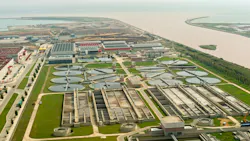
Treating variable and complex wastewater is one of the biggest challenges facing facility operators. Industrial waste streams can vary significantly in conductivity, salinity, turbidity, pH, alkalinity and other key water-quality characteristics, creating treatment conditions that are difficult to manage consistently.
For many facilities, achieving discharge compliance for public waters or publicly owned treatment works (POTWs) requires specialized equipment designed to address specific contaminants or individual water-quality imbalances. Optimizing these systems may also depend on segregating wastewater into concentrated streams for dedicated treatment. In real-world operations, these levels of separation are not always practical. In fact, wastewater complexity, facility limitations, budget constraints and other operational factors can make waste stream segmentation difficult or even impossible.
Many wastewater treatment systems rely on multiple technologies applied sequentially to a combined or primary waste stream. This approach can address a broader range of contaminants and water-quality challenges without requiring the wastewater to be divided into numerous concentrated streams. But it also introduces another challenge: most treatment technologies are designed or tuned to perform within a specific range of wastewater conditions.
In a multi-stage treatment train, each process influences the conditions encountered by the next. Changes in chemistry, treatment byproducts, residual chemicals and shifts in water quality created upstream can all affect the performance of downstream equipment. When those conditions move outside a system’s optimal operating range, treatment efficiency can decline.
The consequences of these changes can compound quickly. Reduced treatment efficiency in any stage may affect subsequent stages, thereby increasing chemical consumption, operating costs and maintenance requirements while placing additional stress on equipment. Over time, these inherent variabilities can contribute to accelerated equipment degradation, unplanned downtime and increased compliance risk.
Managing treatment interactions in single-stream treatment
Different treatment technologies are designed to perform under different water-quality conditions. When several are combined in the same treatment train, those requirements can overlap, conflict or shift as the water moves from one process to the next.
For example, dissolved air flotation (DAF) is commonly used near the front end of a treatment train to remove suspended solids, fats, oils and grease. Upstream, coagulants and flocculants are frequently added to improve separation of fine particles and emulsified material. Downstream, zero liquid discharge (ZLD) systems, can be highly sensitive to fouling and scaling when residual oils, suspended solids, treatment chemicals or other constituents carry through pretreatment. The issue is not that DAF and ZLD are inherently incompatible. Rather, the effectiveness of the upstream separation as well as the chemistry it leaves behind directly influences the operating conditions faced by downstream thermal or membrane processes.
More complex industrial wastewater, such as streams generated by metal finishing or pulp and paper operations, may require several additional processes, each with its own preferred water conditions and operating limits. As treatment trains become more complex, so does the number of interdependencies operators must manage. Each added process creates another opportunity for upstream conditions to influence downstream performance, increasing the potential for efficiency loss, higher chemical consumption, fouling, scaling and operational instability.
This is where pretreatment can make a meaningful difference. Effective, stabilizing pretreatment can reduce variability in how wastewater behaves as it moves through the treatment train, creating more consistent operating conditions for each downstream process. By reducing the burden on individual treatment systems, this added stability can improve performance and efficiency across the entire train. The value is even greater when that stabilization is achieved without adding chemicals or other constituents that can create new challenges downstream.
The unintended byproducts of a crowded treatment train
Conventional single-stream wastewater treatment can introduce its own set of inefficiencies. As water moves through multiple treatment steps, each process can alter its chemistry in ways that affect the next. In some cases, these interactions can generate unintended byproducts that reduce treatment efficiency, contribute to corrosion or fouling, or create new compliance challenges. Operators may respond by adding more chemicals, controls or treatment steps, but each added layer can further increase system complexity and operating cost.
Biological treatment provides a useful example. These systems are typically used to remove biodegradable organic matter, yet residual dissolved organics, biomass and other treatment byproducts can remain in the water as it moves downstream. If sufficient organic precursors reach a chlorination step, they can react with chlorine to form disinfection byproducts such as trihalomethanes (THMs). Depending on a facility’s discharge or reuse requirements, this can create a new treatment challenge downstream rather than fully resolving the original one.
These interactions can also work in reverse. An upstream chemical or industrial treatment step may shift pH, salinity, oxidant residuals or other water-quality conditions in ways that make the stream less favorable for downstream biological treatment, potentially reducing biological activity or nutrient-removal performance.
When only a few processes are involved, many of these interactions can be anticipated and managed. But as more technologies are added to a single treatment train, the number of interdependencies increases rapidly. The result is a treatment process that becomes harder to optimize, more sensitive to changes in wastewater chemistry and increasingly difficult to predict from one stage to the next.
What can operators do?
Treating a single or combined waste stream may not be the ideal approach for every facility, and many plants simply are not designed with the piping, footprint or equipment needed to support waste stream segmentation. For operators of these facilities, there are now other ways to optimize their treatment trains and get the most out of their single stream treatment.
New and emerging pretreatment and water-conditioning technologies can offer a different path. While traditional wastewater treatment generally focuses on adding chemicals or applying processes that remove, separate, convert or destroy contaminants, water conditioning technologies take a broader approach; they focus on influencing the underlying kinetic and interfacial environment in which contaminants, treatment chemicals and equipment surfaces interact.
Catalytic water treatment (CWT) is one example. Rather than targeting a single contaminant, CWT uses passive catalysis to influence inherent reduction-oxidation behavior and interfacial reactions within water. This generally stabilizes aqueous environments and creates more favorable conditions for downstream treatment processes.
Benefits of CWT can be especially significant in single-stream systems. By catalytically reducing variability in water chemistry and reaction kinetics, CWT creates more consistent feed conditions across the treatment train. This can reduce deposition, scaling, corrosion and fouling while improving the operating environment for filtration, membrane, biological, separation and thermal processes. Rather than adding another chemical step to solve a single problem, catalytic conditioning can improve conditions across multiple stages of treatment.
For facilities managing the unpredictable operating costs associated with highly variable wastewater, that broader effect of simple CWT installs can be particularly valuable. Although a treatment train may still contain the same DAF, biological, membrane, filtration or ZLD equipment, better-conditioned water entering those systems can reduce the severity of the interactions that make single-stream treatment difficult in the first place. The result can be greater treatment efficiency, lower chemical demand, reduced maintenance burden and more predictable operating performance.
Digital modeling can further strengthen this approach by helping operators understand how changes at one stage affect the rest of the treatment train. With sufficient operating data, modeling tools can identify interdependencies, compare treatment scenarios and focus attention on the adjustments most likely to improve overall system performance.
Finally, disciplined monitoring remains equally important. Detailed operating records can reveal performance drift, abnormal chemical demand, accelerated fouling and equipment degradation while helping operators trace inefficiencies back to their source.
While waste stream segmentation can help optimize treatment of complex industrial wastewater, it is not always practical or possible. Facilities treating a single combined stream must manage the interactions between multiple treatment processes, where changing water conditions and unintended byproducts can contribute to fouling, corrosion, equipment degradation and costly downtime. Advances in catalytic conditioning, process modeling and monitoring are creating new ways to address that challenge, which helps operators better understand their wastewater, reduce variability across the treatment train and improve the performance of the infrastructure already in place.
About the Author
Les Flynn
Les Flynn is President of CAPE HydroTek, a catalytic water conditioning and treatment technology solutions provider with a mission to deliver scalable, sustainable, and compliant water management technologies that solve urgent environmental challenges. He can be reached at [email protected].