Oxidative diversity: A functional framework for understanding oxidative biofilm control in water systems
Key Highlights
- Biofilms are complex microbial communities embedded in extracellular polymeric substances that resist conventional disinfection methods.
- Traditional evaluation metrics like oxidant concentration and ORP do not fully capture the diverse oxidative mechanisms needed for effective biofilm control.
- Oxidative Diversity refers to the collective functionality of multiple reactive species, each contributing unique mechanisms such as rapid oxidation, targeted modification, and deep penetration.

Biofilm formation remains one of the most persistent challenges in water treatment systems due to the complex architecture and protective properties of microbial communities embedded within extracellular polymeric substances (EPS). Traditional evaluation of oxidative treatment strategies has frequently emphasized oxidant concentration, oxidation-reduction potential (ORP), or individual oxidant strength. While these parameters provide useful operational information, they do not fully describe the diverse oxidative mechanisms required to prevent, destabilize, and remove established biofilm structures.
Biofilms represent dynamic biological and chemical systems composed of microbial cells, extracellular polymers, proteins, lipids, extracellular DNA (eDNA), mineral associations, and transparent exopolymer particles (TEP). Effective oxidative biofilm control may therefore involve the coordinated action of multiple reactive species capable of targeting different structural and functional components of the biofilm matrix.
This manuscript introduces the concept of Oxidative Diversity as a framework to describe the capacity of oxidative chemistry to establish and sustain a dynamic network of reactive oxygen species and related oxidizing species capable of supporting multiple complementary oxidative mechanisms simultaneously within a complex system.
Rather than evaluating oxidative technologies solely by the strength or concentration of a primary oxidant, this framework considers the broader oxidative functionality provided by the diversity, reactivity, selectivity, persistence, and interaction of oxidative species. Reactive oxygen species (ROS), reactive halogen species (RHS), and reactive nitrogen species (RNS) relevant to water treatment are reviewed according to their mechanistic contributions toward biofilm prevention, destabilization, and removal.
By integrating established principles of biofilm science and oxidative chemistry, the Oxidative Diversity framework provides a mechanistic approach for understanding how different oxidative systems interact with complex biofilm environments.
Introduction
Biofilm control has historically been approached primarily through the lens of microbial inactivation. In water treatment applications, oxidative agents are commonly evaluated according to their ability to reduce planktonic microorganisms, maintain disinfectant residuals, or achieve specific oxidation-reduction potential (ORP) targets.
While these parameters remain important, biofilms present a substantially different challenge than suspended microbial populations.
Microorganisms within biofilms exist as organized communities embedded within a hydrated extracellular matrix. This matrix creates physical and chemical barriers that influence oxidant transport, reaction pathways, and treatment effectiveness [1]. As a result, microbial survival within biofilms is not determined only by the susceptibility of individual cells, but also by the resilience of the surrounding structure.
The extracellular polymeric substance (EPS) matrix consists of polysaccharides, proteins, lipids, extracellular DNA, mineral associations, and other organic components that contribute to adhesion, cohesion, and protection [2]. In aquatic environments, transparent exopolymer particles (TEP) can further contribute to organic conditioning layers that promote microbial attachment and biofilm initiation [3] [4].
![Figure 1: Biofilm architecture and structural components [1] [2]](https://img.watertechonline.com/files/base/ebm/wto/image/2026/09/6aa9539f01e02dc62cf4b9ba-biofilm_architecture__components.png?auto=format,compress&fit=max&q=45?w=250&width=250)
The complexity of biofilms suggests that effective oxidative control requires more than microbial inactivation alone. Oxidative processes may contribute through several complementary mechanisms, including:
- prevention of initial attachment and matrix formation,
- destabilization of protective extracellular structures,
- disruption of microbial function,
- enhancement of biofilm detachment and removal.
These mechanisms are influenced not only by oxidant concentration or oxidation potential, but also by the specific chemical behavior of the reactive species involved.
Different oxidative species exhibit distinct chemical behaviors that influence their function within complex biofilm environments. Their effectiveness is determined not only by oxidation potential, but also by reaction kinetics, selectivity toward specific molecular targets, ability to diffuse through structured matrices, stability within the aqueous environment, and participation in secondary oxidative pathways that can extend or regenerate oxidative activity.
Therefore, understanding oxidative biofilm control requires a shift from evaluating individual oxidants based on isolated chemical properties toward evaluating the broader oxidative functionality generated by dynamic networks of reactive species.
Oxidative agents and reactive species in water treatment
Oxidative water treatment technologies are commonly classified according to the chemical agent applied to the system, such as chlorine, ozone, hydrogen peroxide, chlorine dioxide, bromine-based oxidants, or other advanced oxidation processes [5]. While this classification is useful from an operational perspective, the biological and chemical effects produced within a biofilm environment are ultimately determined by the reactive species generated and their interaction with organic and microbial structures.
Different oxidative agents may produce a single dominant oxidizing species or establish a broader network of reactive intermediates. These species can include reactive oxygen species (ROS), reactive chlorine species (RCS), reactive bromine species (RBS), and reactive nitrogen species (RNS), each contributing different chemical behaviors based on their electron-transfer properties, molecular structure, stability, and reaction pathways. [5] [8]
The major oxidative agents used in water treatment and the principal reactive species associated with their oxidative activity are summarized below.
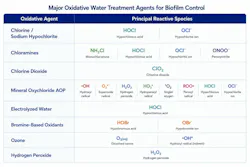
The presence of a reactive species alone, however, does not fully describe its contribution to biofilm control. Oxidative species differ substantially in how they interact with complex organic matrices. Highly reactive species may provide rapid oxidation and fragmentation of resistant structures, while more selective or stable species may provide longer persistence, deeper penetration, or targeted modification of specific biomolecules.
For example, hydroxyl radicals (•OH) exhibit among the highest oxidation potentials and react rapidly with a broad range of organic molecules, resulting in strong but localized oxidative activity [5]. In contrast, species such as hydrogen peroxide (H₂O₂), monochloramine (NH₂Cl), and chlorine dioxide (ClO₂) exhibit greater persistence and diffusion capability, allowing oxidative activity to reach regions that may be less accessible to extremely short-lived species. [13]
Similarly, reactive halogen species such as hypochlorous acid (HOCl) and hypobromous acid (HOBr) provide effective oxidation of biological structures through reactions with proteins, enzymes, and other cellular components [10] [11] , while additional reactive species may contribute to extended oxidative pathways and redox cycling.
The relative characteristics of major oxidative species relevant to water treatment are summarized according to oxidation potential, reactivity, selectivity, and stability.
![Figure 3: Characterization of main oxidative species in water treatment [5] [8] [9] [11]](https://img.watertechonline.com/files/base/ebm/wto/image/2026/09/6aa953e5cc711d223d0b39b5-characterization_main_oxidative_species.png?auto=format,compress&fit=max&q=45?w=250&width=250)
These differences demonstrate that oxidative effectiveness cannot be described by a single parameter such as oxidation potential, concentration, or residual persistence. Each characteristic represents only one dimension of oxidative behavior.
In complex systems such as biofilms, where physical barriers, chemical gradients, and diverse molecular targets coexist, effective oxidative control depends on the ability of reactive species to contribute complementary functions. This broader oxidative functionality forms the foundation for evaluating oxidative processes beyond individual oxidant strength.
Mechanistic requirements for oxidative biofilm control
The structural complexity of biofilms creates a challenge that extends beyond microbial inactivation. While destruction of embedded microorganisms is an important objective, long-term biofilm control requires addressing the extracellular structures and biochemical interactions that allow biofilms to attach, develop, resist treatment, and re-establish after exposure to oxidative stress.
The extracellular matrix acts as both a physical barrier and a reactive environment. Oxidative species entering this structure encounter a complex network of polysaccharides, proteins, lipids, extracellular DNA, mineral associations, and other organic compounds. These components create multiple oxidative targets with different chemical properties, requiring complementary mechanisms for effective disruption. [1] [13]
As a result, oxidative biofilm control can be understood through three major functional objectives:
Biofilm prevention focuses on limiting the early conditions required for attachment and development. This includes oxidation of organic precursors such as transparent exopolymer particles (TEP), reduction of conditioning layer formation, maintenance of oxidative pressure, and interference with microbial communication pathways involved in coordinated biofilm growth. [3]
Biofilm destabilization targets the structural integrity of established biofilms. Oxidative processes contribute to fragmentation of extracellular polymeric substances (EPS), disruption of organic and mineral interactions, oxidation of extracellular DNA, modification of proteins and enzymes, and damage to microbial cellular structures. These mechanisms weaken the protective matrix and reduce the resilience that allows biofilms to persist.
Biofilm removal involves processes that enable oxidative activity to penetrate beyond the outer biofilm surface, degrade internal matrix components, propagate oxidative reactions, and promote detachment of weakened structures. Removal therefore depends not only on microbial control but also on progressive loss of matrix stability and cohesion. [12] [13]
The contribution of individual oxidative species varies across these mechanisms. Highly reactive species may rapidly attack resistant organic structures, while more stable or selective species may support penetration, sustained oxidative activity, or targeted reactions within specific biofilm regions.
The following framework organizes oxidative biofilm control according to the primary mechanisms required for prevention, destabilization, and removal, and identifies the main oxidative species contributing to each process.
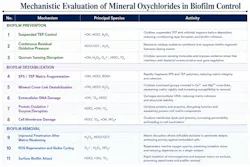
This mechanistic approach highlights that oxidative performance cannot be predicted solely by the presence or concentration of a single oxidant. Instead, biofilm control depends on how effectively an oxidative system provides the range of functions required to interact with a complex and dynamic biological structure.
Oxidative diversity: A functional framework for biofilm control
The evaluation of oxidative processes in water treatment has traditionally relied on measurable parameters such as oxidant concentration, oxidation-reduction potential (ORP), reaction rates, and microbial inactivation performance. These parameters provide valuable information; however, they do not fully describe the ability of an oxidative system to interact with the structural and chemical complexity of biofilms.
Biofilm control requires simultaneous interaction with diverse targets, including extracellular polymers, proteins, lipids, nucleic acids, mineral-associated structures, microbial cells, and chemical signaling pathways. Because these components differ significantly in accessibility and chemical reactivity, no single oxidative characteristic can describe the complete interaction between an oxidative treatment and a biofilm system.
Within this context, this manuscript introduces the concept of Oxidative Diversity as a framework for evaluating the range of oxidative functions supported by a given chemistry:
Oxidative Diversity is defined as the capacity of an oxidative chemistry to establish and sustain a dynamic network of reactive oxygen species and related oxidizing species capable of supporting multiple complementary oxidative mechanisms simultaneously within a complex system.
The concept of Oxidative Diversity shifts the evaluation of oxidative systems from the presence of a single dominant oxidant toward the collective functionality generated by multiple oxidative pathways. A diverse oxidative environment is not defined only by the number of reactive species alone, but by the ability of those species to provide complementary functions.
These functions may include rapid oxidation of resistant organic structures, selective modification of specific molecular targets, penetration into protected environments, propagation of secondary oxidative reactions, and maintenance of oxidative conditions over time. [5] [13]
Importantly, Oxidative Diversity does not replace established chemical parameters such as oxidation potential or reaction kinetics. Instead, it integrates these properties into a broader framework that considers how different oxidative behaviors contribute collectively within complex environments.
For example, a highly reactive species may provide rapid oxidation but limited transport distance due to immediate consumption [13]. Conversely, a more stable or selective species may contribute through persistence, diffusion, or targeted reactions rather than maximum oxidative strength. Both types of activity may provide important contributions depending on the structure and stage of biofilm development.
Therefore, oxidative biofilm control should not be interpreted solely as a competition between stronger and weaker oxidants, but as the interaction between oxidative species with different and potentially complementary functional roles.
The relationship between major oxidative species and their functional contributions to biofilm control is summarized below.
![Figure 5: Roles of oxidative species in biofil control in water systems [5] [9] [7] [14] [11]](https://img.watertechonline.com/files/base/ebm/wto/image/2026/09/6aa954230b7ef58870d5ed23-roles_oxidative_species_biofilm_control.png?auto=format,compress&fit=max&q=45?w=250&width=250)
The Oxidative Diversity framework provides a mechanism-based approach for understanding why oxidative treatments with similar measured residual concentrations or oxidation potentials may produce different outcomes in complex biofilm environments. These differences arise not only from how much oxidative capacity is present, but from how that capacity is distributed across the mechanisms required for biofilm prevention, destabilization, and removal.
Implications for evaluating oxidative biofilm control strategies
The application of oxidative treatments in water systems has historically focused on controlling measurable parameters such as oxidant dose, residual concentration, exposure time, and oxidation-reduction potential. These measurements remain essential for operational monitoring; however, they represent indicators of oxidative conditions rather than complete descriptions of oxidative functionality.
Biofilms create environments where chemical transport, reaction kinetics, and structural complexity strongly influence treatment outcomes [1] [13]. An oxidative species with high oxidation potential may rapidly react with accessible material at the biofilm surface, while other species with greater stability or selectivity may contribute through diffusion into deeper regions, sustained activity, or targeted interactions with specific matrix components.
This distinction is particularly important because mature biofilms are not homogeneous structures. Oxidative demand is distributed throughout layers containing different chemical and biological targets. Effective control may require multiple complementary processes occurring simultaneously or sequentially, including disruption of external barriers, penetration into protected regions, degradation of internal matrix components, and suppression of microbial recovery mechanisms. Effective oxidative control depends on whether the chemistry provides the right combination of oxidative functions for the complexity of the target system.
The Oxidative Diversity framework provides a method for evaluating oxidative systems according to their mechanistic coverage rather than relying exclusively on individual chemical properties. Under this approach, oxidative capacity is interpreted according to the functional contributions provided by the reactive species present within the system.
A broader oxidative functionality may increase the number of mechanisms available to interact with complex biofilm structures. Included among them, the ability to combine rapid oxidation, selective reactions, penetration, propagation of secondary oxidative pathways, and sustained oxidative pressure and activity. Oxidative Diversity is not solely the presence of a larger number of reactive species. The effectiveness of an oxidative system depends on whether those species are generated under relevant conditions, persist long enough to contribute meaningful activity, and interact through pathways that support biofilm prevention, destabilization, or removal.
When comparing oxidative treatment strategies, different agents may achieve microbial inactivation while providing different levels of interaction with the extracellular matrix and structural components responsible for biofilm resilience. Therefore, evaluating oxidative performance requires consideration of both biological control and the chemical processes required to modify the biofilm environment.
By integrating oxidative chemistry with biofilm structure and function, the Oxidative Diversity framework provides a broader perspective for understanding treatment outcomes and designing strategies for complex water systems.
Conclusion
Biofilm control in water systems represents a complex challenge that extends beyond microbial inactivation. The protective architecture of biofilms, formed through interactions between microorganisms, extracellular polymeric substances, transparent exopolymer particles, extracellular DNA, proteins, minerals, and other organic components, creates a dynamic environment where oxidative treatments must interact with multiple chemical and biological targets.
Traditional evaluation of oxidative treatments has often emphasized individual parameters such as oxidant concentration, residual persistence, oxidation potential, or microbial reduction efficiency. While these measurements provide important operational information, they do not fully describe the diversity of oxidative interactions required to prevent biofilm formation, destabilize established structures, and promote removal.
The framework presented in this manuscript proposes that oxidative biofilm control can be better understood by evaluating the functional roles of oxidative species and the mechanisms they support. Different reactive oxygen, halogen, and nitrogen species contribute through distinct properties, including rapid oxidation, selective reactivity, penetration, sustained activity, and propagation of secondary oxidative pathways.
The concept of Oxidative Diversity provides an integrated approach for describing the capacity of oxidative chemistries to generate complementary oxidative functions within complex systems. Rather than defining oxidative performance solely by the strength of an individual oxidant, this framework considers how multiple reactive species collectively contribute to broader oxidative functionality.
Understanding oxidative treatments through this mechanistic perspective may support improved evaluation, selection, and optimization of strategies for biofilm management in water systems. As knowledge of biofilm complexity continues to advance, integrating biofilm structural science with oxidative chemistry provides an opportunity to develop more comprehensive approaches for controlling one of the most persistent challenges in water treatment.
Conflict of interest statement
The author is affiliated with Envirocleen LLC, a company involved in oxidative water treatment technologies. The manuscript presents a general framework for oxidative biofilm control and does not evaluate or promote any specific commercial product.
Funding statement
The author received no external funding for this work.
Reference library
- Flemming HC, Wingender J, Szewzyk U, Steinberg P, Rice SA, Kjelleberg S. (2016). Biofilms: an emergent form of bacterial life. Nature Reviews Microbiology, 14, 563–575.
- Flemming HC, Wingender J. (2010). The biofilm matrix. Nature Reviews Microbiology, 8, 623–633.
- Passow U. (2002). Transparent exopolymer particles (TEP) in aquatic environments. Progress in Oceanography, 55, 287–333.
- Berman T, Holenberg M. (2005). Don’t fall foul of biofilm through high TEP levels. Filtration & Separation, 42(4), 30–32.
- von Sonntag C. (2008). Advanced Oxidation Processes: Mechanistic Aspects. IWA Publishing.
- Imlay JA. (2013). The molecular mechanisms and physiological consequences of oxidative stress: lessons from a model bacterium. Nature Reviews Microbiology, 11, 443–454.
- Davies MJ. (2003). Singlet oxygen-mediated damage to proteins and its consequences. Biochemical and Biophysical Research Communications, 305, 761–770.
- von Gunten U. (2003). Ozonation of drinking water: Part I. Oxidation kinetics and product formation. Water Research, 37, 1443–1467.
- Winterbourn CC. (2008). Reconciling the chemistry and biology of reactive oxygen species. Nature Chemical Biology, 4, 278–286.
- Pattison DI, Davies MJ. (2001). Absolute rate constants for the reaction of hypochlorous acid with protein side chains and peptide bonds. Chemical Research in Toxicology, 14, 1453–1464.
- Heeb MB, Criquet J, Zimmermann-Steffens SG, von Gunten U. (2014). Oxidative treatment of bromide-containing waters: formation of bromine and its reactions. Water Research, 48, 15–42.
- de Beer D, Srinivasan R, Stewart PS. (1994). Direct measurement of chlorine penetration into biofilms during disinfection. Applied and Environmental Microbiology.
- Stewart PS. (2003). Diffusion in biofilms. Journal of Bacteriology, 185, 1485–1491.
- Radi R. (2013). Peroxynitrite, a stealthy biological oxidant. Journal of Biological Chemistry, 288, 26464–26472.
About the Author
Emma Flanagan
Emma Flanagan is the CEO and CTO of Envirocleen, LLC, an Illinois-based water treatment company specializing in advanced oxidation technologies and biofilm control. Her work focuses on oxidative mechanisms in water systems, including the generation and interactions of reactive oxygen and chlorine species, redox chemistry, and their roles in biofilm and extracellular polymeric substance (EPS) disruption. Her research interests include mineral oxychloride chemistry, homogeneous catalytic oxidation involving transition minerals, and reaction pathways related to Fenton and Haber-Weiss chemistry.
She leads the technical development and application of mineral oxychloride-based water treatment technologies, including Bio-hydrox®, for microbial control, biofilm management, and water treatment applications. Her professional work spans industrial and municipal water treatment, premise plumbing and healthcare water systems, wastewater treatment, agriculture, aquaculture, and other applications where microbial growth and biofouling affect water quality and process performance.
Emma holds an M.S. in Sanitary Engineering from the IHE Delft Institute for Water Education in the Netherlands. Her professional activities include applied research, technical education, technology development, and consulting in water treatment and oxidative biofilm control.